List of Top AI Document Redaction APIs for Seamless Workflow Integration in 2025
List of Top AI Document Redaction APIs for Seamless Workflow Integration in 2025
Picture this: A healthcare organization accidentally exposes 10,000 patient records because someone missed a single Social Security number buried in page 47 of a scanned medical file. The HIPAA fine? $1.5 million. The reputational damage? Priceless. This nightmare scenario plays out more often than you'd think, because manual document redaction—even with the best intentions—is fundamentally broken.
In 2025, data privacy regulations like GDPR, CCPA, and HIPAA aren't suggestions; they're mandates backed by crushing penalties. Organizations processing sensitive documents face an impossible choice: slow down operations with manual review, or risk catastrophic compliance failures. Enter AI document redaction APIs—the technology transforming how businesses protect confidential information at scale.
This guide cuts through the noise to help you find the best AI document redaction APIs for 2025. We've tested the leading solutions, analyzed their real-world performance, and distilled everything into actionable insights. Whether you're a legal team drowning in discovery documents, a healthcare provider managing PHI, or a financial institution securing transaction data, you'll discover which APIs deliver permanent, compliant redaction without slowing your workflow. For teams needing straightforward PDF redaction with enterprise-grade security, tools like Smallpdf's redaction solution offer permanent removal with TLS encryption and GDPR compliance—perfect for organizations prioritizing both speed and regulatory adherence.
What Is an AI Document Redaction API and How Does It Work?
An AI document redaction API is a machine learning-powered tool that automatically detects and permanently removes sensitive information from documents, images, and digital content. Unlike manual redaction—where humans meticulously review each page, often missing critical data—AI-powered systems process documents in seconds while identifying every instance of personally identifiable information (PII), Protected Health Information (PHI), and confidential data with remarkable precision.
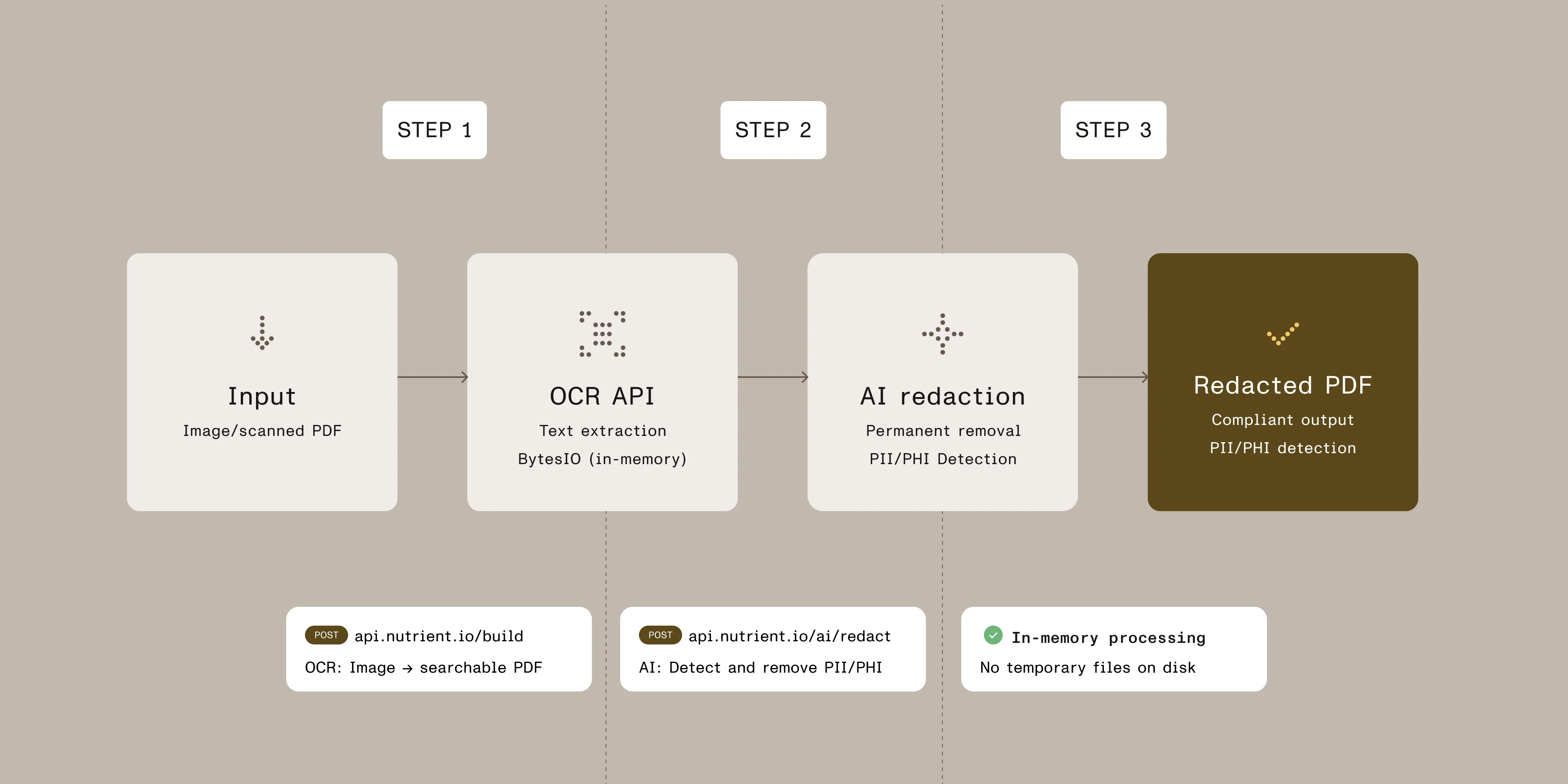
The technology behind these APIs combines three core capabilities. First, Optical Character Recognition (OCR) converts scanned documents and images into machine-readable text, working seamlessly even with handwritten notes or poor-quality scans. Next, Natural Language Processing (NLP) analyzes context to understand what constitutes sensitive information—distinguishing between "John Smith" as a person's name versus a company name. Finally, specialized detection algorithms identify patterns like Social Security numbers, credit card details, and medical record numbers with accuracy that surpasses manual review.
Real-world applications span critical sectors: legal firms process discovery documents for litigation, healthcare facilities automatically remove PHI from clinical documentation and research studies, financial institutions protect customer data in transaction records, and government agencies comply with FOIA requests while safeguarding national security information. Medical facilities using AI redaction report reducing manual review time by up to 98%, transforming weeks of work into hours.
For organizations prioritizing both speed and security, solutions like Smallpdf's Redact PDF tool combine intuitive drag-and-drop interfaces with enterprise-grade protection—featuring TLS encryption, GDPR compliance, and automatic file deletion after processing, ensuring redacted information is permanently irretrievable while maintaining operational efficiency.
Key Features to Look for in Document Redaction APIs in 2025
Selecting the right document redaction API requires evaluating capabilities that go beyond basic text removal. Think of it like choosing a security system for your home—you need comprehensive protection, not just a single lock on the front door.
Essential accuracy and detection capabilities form the foundation. Modern APIs must achieve over 98% accuracy on standard documents while detecting personally identifiable information (PII) across multiple formats. The best solutions, including Smallpdf's redaction tool, offer permanent removal that ensures redacted information cannot be recovered—a critical feature for legal and healthcare organizations.
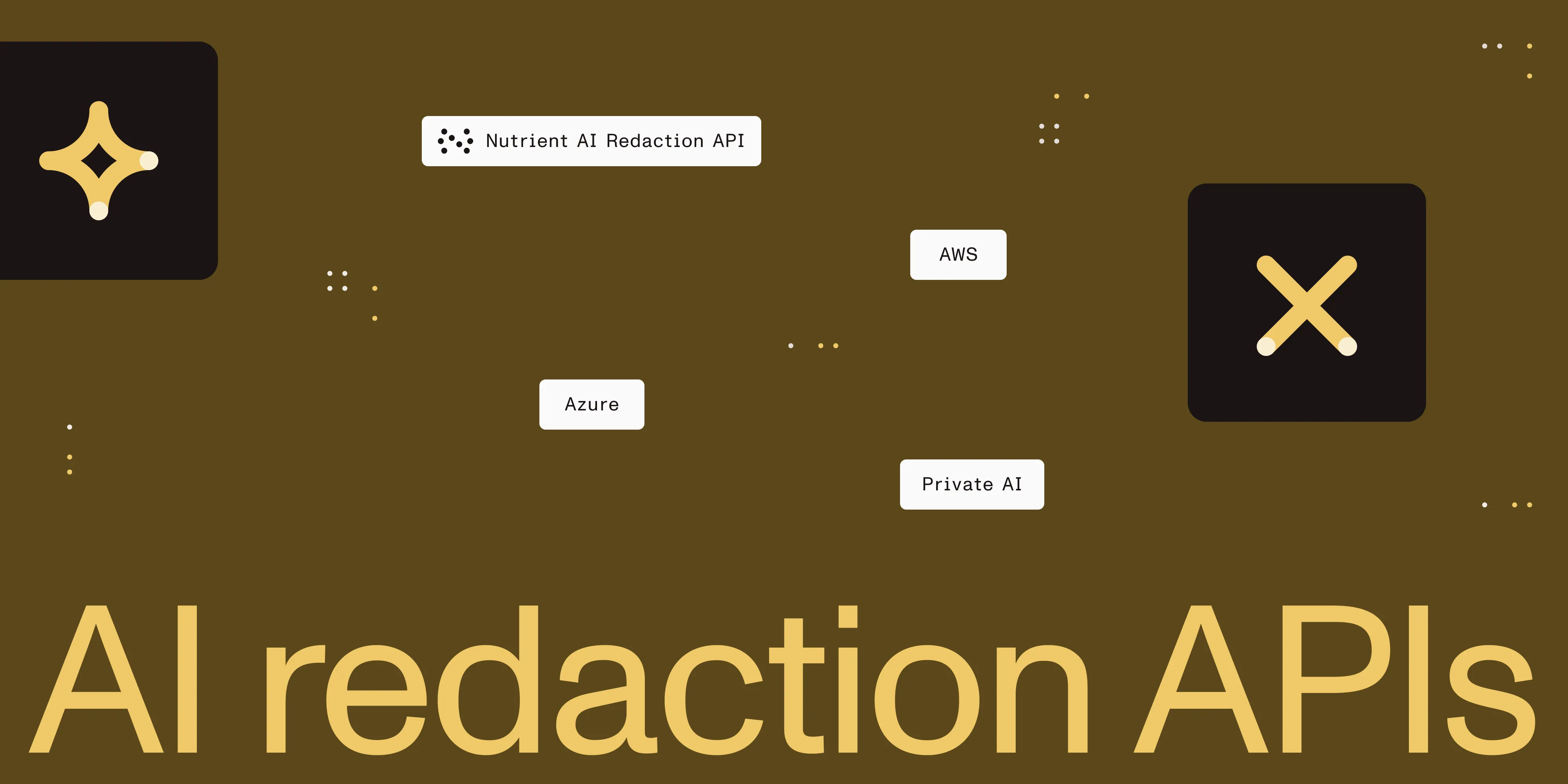
Multi-format support and integration flexibility separate leaders from basic tools. Look for APIs that handle PDFs, images, videos, and scanned documents seamlessly. According to Nutrient's comprehensive comparison guide, top-tier solutions like Nutrient AI redaction API, Private AI, and Azure AI Language process native PDFs directly while maintaining accuracy. For multilingual content, prioritize platforms with robust language detection across formats.
Compliance certifications and deployment options are non-negotiable for enterprise use. Your API should carry SOC 2, GDPR, and HIPAA certifications as standard—not optional add-ons. Cloud-based APIs like Nutrient and AWS Comprehend offer 2-4 week deployment timelines with minimal setup, while deployment flexibility through on-premises, cloud, or hybrid models accommodates different IT strategies and data sovereignty requirements.
Scalability and audit capabilities ensure long-term value. Choose solutions that process thousands of documents monthly while maintaining unified audit trails—essential when regulatory bodies come knocking for proof of compliance.
Top AI Document Redaction APIs for 2025: Complete Comparison
Choosing the right AI document redaction API can transform how your organization handles sensitive data. After testing leading solutions in the market, here's a comprehensive breakdown of the top options and what makes each unique.
Nutrient AI Redaction API: The Compliance-First Choice
For organizations prioritizing permanent data removal and regulatory compliance, Nutrient AI Redaction API stands out as the optimal solution. Most compliance organizations deploy this as their primary document redaction tool because it processes native PDFs directly and offers true permanent removal—not just visual covering.
What sets it apart is the turnkey deployment (2-4 weeks) with SOC 2 and GDPR certifications built-in. You get 200 free credits to test with your actual documents, no credit card required. The API handles scanned documents and images efficiently, making it ideal for industries like healthcare, finance, and legal where regulatory compliance isn't optional.
Best for: Healthcare organizations, financial institutions, legal firms requiring HIPAA/GDPR compliance
Private AI: Multilingual Powerhouse
If your workflow involves multiple languages and document formats beyond PDF, Private AI excels at handling diverse content types. This solution processes various file formats while maintaining strong privacy protections. Consider pairing it with AssemblyAI for audio redaction needs.
Best for: Global enterprises with multilingual document processing requirements
Azure AI Language & AWS Comprehend: The Enterprise Giants
Both Microsoft Azure AI Language and AWS Comprehend offer fast cloud deployment with robust natural language processing capabilities. According to Gartner Peer Insights, Azure provides advanced data protection features particularly valuable for financial data.
Best for: Organizations already invested in Microsoft or AWS ecosystems seeking integrated solutions
Smallpdf Redact PDF: A User-Friendly Solution for Quick Document Redaction
Not every organization needs enterprise-level complexity when handling sensitive documents. Sometimes you just need to quickly redact a contract before sharing it with a client, or permanently remove personal information from an HR file before filing it away. That's exactly where Smallpdf's Redact PDF tool shines—it delivers permanent, secure redaction without the learning curve of complex API integrations.
What makes this solution stand out is its drag-and-drop simplicity combined with enterprise-grade security. You can highlight sensitive information directly in your browser, apply permanent redaction that makes data completely unrecoverable, and download your protected document—all without creating an account or installing software. Behind this seamless experience lies TLS encryption protecting your files in transit and GDPR-compliant data handling that automatically deletes files after processing.
For teams managing document workflows across the entire Smallpdf ecosystem, the redaction tool integrates naturally with other features like compression, conversion, and organization tools. Whether you're a small legal practice handling a dozen documents weekly or a growing business standardizing privacy procedures, this web-based solution eliminates the gap between "quick and risky" manual methods and "powerful but complicated" enterprise APIs—giving you permanent protection without the complexity.
Industry-Specific Applications: Choosing the Right API for Your Workflow
Selecting the right document redaction API isn't a one-size-fits-all decision—your industry's unique compliance requirements and workflow patterns should guide your choice. According to What Is Redaction? The Complete Guide for 2025, redaction sits at the center of regulations like HIPAA, FOIA, FERPA, PCI-DSS, GDPR, and CJIS, each demanding tailored approaches.
Legal Teams & eDiscovery: Law firms handling discovery documents need bulk processing capabilities and precise tracking features. Best Redaction Software in the US 2025 highlights that legal professionals require verification data demonstrating adherence to standards. For straightforward PDF redaction workflows, Smallpdf's Redact PDF tool offers a user-friendly option with TLS encryption and GDPR compliance, making it ideal for legal teams needing quick, secure redaction without complex setup.
Healthcare Organizations: PHI protection demands HIPAA-compliant solutions with audit trails. Best Document Redaction APIs in 2025 notes healthcare providers among industries benefiting from centralized API management that validates data across multiple services for accuracy.
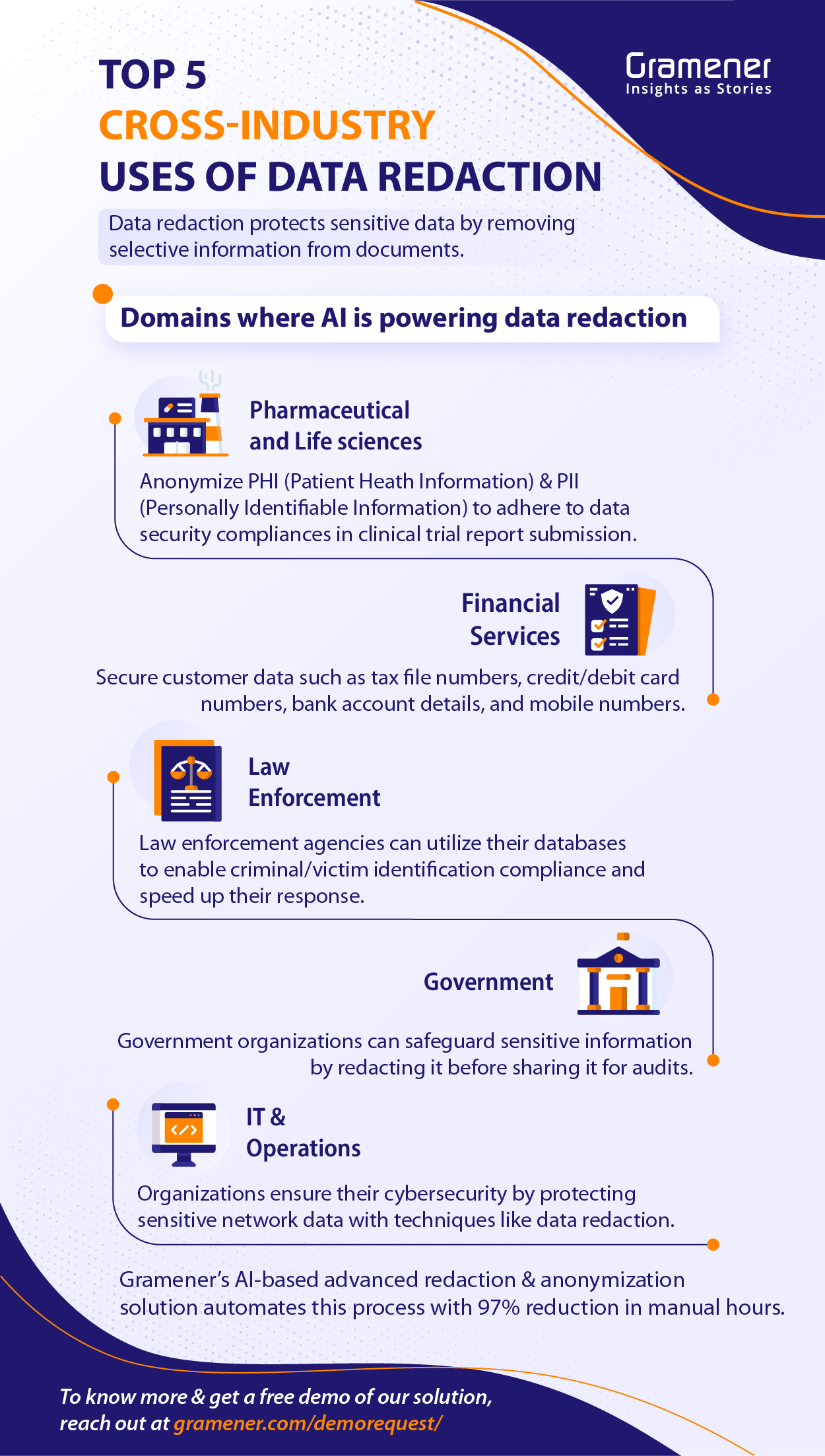
Government Agencies: FOIA request processing requires high-volume automation. Document Redaction for FOIA Requests emphasizes that advanced FOIA redaction software streamlines request-response processes through automation, crucial for agencies managing public records.
Financial Services & HR Departments: PCI-DSS compliance and employee privacy necessitate APIs that handle structured data formats while maintaining transactional integrity across multiple document types.
Implementation Guide: Integrating Document Redaction APIs into Your Workflow
Integrating document redaction APIs doesn't have to be complicated. Whether you're automating compliance workflows or protecting sensitive customer data, the right implementation strategy can have your system running smoothly within weeks.
Evaluation and Proof-of-Concept Testing
Start by testing with your actual documents—not sample files. According to Best AI redaction APIs: Complete comparison guide for 2025, turnkey cloud APIs typically need only 2-4 weeks for deployment. Request free trial credits to validate accuracy against your specific document types, whether they're native PDFs, scanned images, or multilingual content.
Create a simple evaluation matrix comparing detection accuracy, processing speed, and false positive rates. Test edge cases like handwritten notes, watermarks, or rotated text that commonly trip up less sophisticated systems.
Authentication and Error Handling Basics
Most modern redaction APIs use OAuth 2.0 or API key authentication. Here's a basic implementation pattern:
import requests

headers = {
    'Authorization': 'Bearer YOUR_API_KEY',
    'Content-Type': 'application/pdf'
}

response = requests.post(
    'https://api.provider.com/redact',
    headers=headers,
    files={'document': open('contract.pdf', 'rb')},
    timeout=30
)

if response.status_code == 200:
    redacted_doc = response.content
else:
    # Implement retry logic with exponential backoff
    handle_error(response.status_code)
Human-in-the-Loop Validation Strategy
Even the best AI makes mistakes. AI Redaction: Everything you need to know in 2025 emphasizes that AI redaction reduces human error but shouldn't eliminate human oversight entirely for high-stakes documents. Implement a confidence threshold—flag redactions below 95% confidence for manual review.
For streamlined workflow integration, consider Smallpdf's redaction tool as your primary solution. It offers permanent, irrecoverable redaction with TLS encryption and GDPR compliance, making it ideal for teams that need secure, user-friendly processing without complex API setup. The drag-and-drop interface works seamlessly for both automated batch processing and quick manual reviews.
Batch Processing and Monitoring
Process documents in batches of 10-50 for optimal throughput. According to Document Redaction experts at Eden AI, combining multiple APIs through centralized platforms provides higher accuracy through cross-validation. Monitor key metrics: processing time per page, API error rates, and redaction accuracy scores. Set up alerts when accuracy drops below your threshold or API latency exceeds acceptable limits.
Compliance and Security Considerations for AI-Powered Redaction
When implementing AI document redaction APIs, understanding regulatory requirements isn't just about avoiding fines—it's about building systems that stand up under legal scrutiny. The compliance landscape in 2025 demands more than checkbox approaches; organizations need defensible workflows that can be explained, audited, and replicated.
Critical Regulatory Frameworks
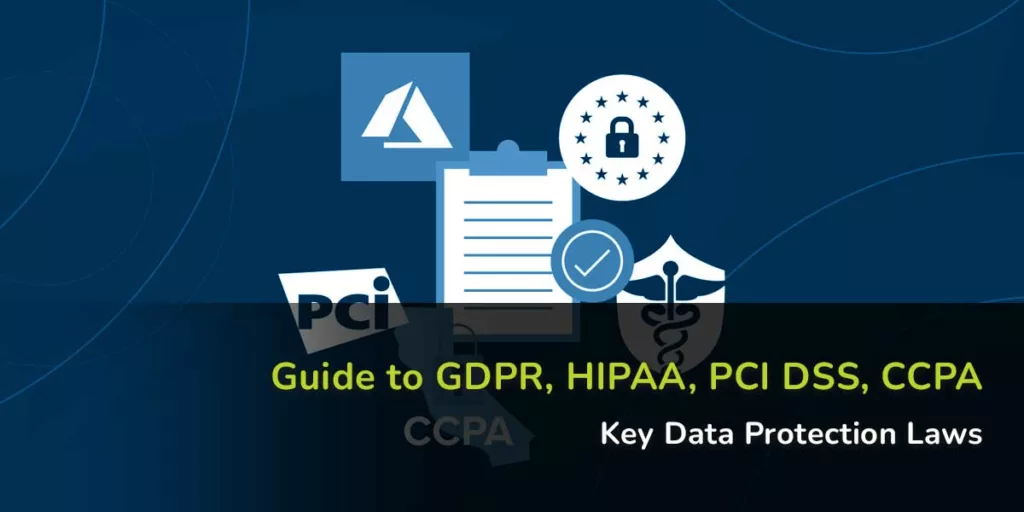
According to Redaction Under Scrutiny: Why Defensible Redaction Workflows Are Now a Compliance Mandate, modern redaction must satisfy multiple overlapping regulations. For healthcare organizations, the HIPAA Privacy Rule & Regulations 2025 requires strict protection of electronic Protected Health Information (ePHI) with enhanced breach notification requirements. Financial services must navigate both GDPR Article 17's right to erasure for EU data subjects and CCPA requirements for California residents.
Building Defensible Workflows
Smallpdf's redaction API stands out by embedding compliance into its architecture. Using TLS encryption and GDPR-compliant data handling, it enables organizations to permanently remove sensitive information with automatic file deletion after processing—addressing the core requirement that redactions must be traceable and rule-based. As data protection experts at CaseGuard note, cloud redaction requires demonstrating exactly how sensitive information is handled through secure infrastructure and audit-ready workflows.
Best practices include maintaining detailed audit trails documenting what was redacted, by whom, and under which regulatory rule. Organizations should verify their redaction API provides data residency controls, automated compliance logging, and the ability to demonstrate that over-redaction and under-redaction risks are systematically managed—because in 2025, unexplainable redactions simply won't hold up in court.
Cost Comparison and ROI: Making the Business Case for Automated Redaction

Understanding the financial impact of AI document redaction isn't just about comparing price tags—it's about calculating the true cost of your current manual process versus automated efficiency. According to document processing statistics for 2025, organizations implementing document automation see an average ROI of 200–300% within the first year, with businesses saving $8–12 per document processed.
Common Pricing Models Across Providers:
- Per-page or per-document: Best for occasional redaction needs
- Subscription tiers: Monthly or annual plans based on volume (e.g., 500-10,000 pages/month)
- API call pricing: Pay-per-request model charging $0.01–$0.10 per page processed
- Token-based: AI redaction APIs often charge per token processed, with costs varying widely across providers
The Redaction Cost Calculator reveals the hidden expenses of manual redaction: a legal team spending 30 minutes per document at $150/hour costs $75 per redaction, while automated solutions like Smallpdf's PDF Redaction Tool process the same document in seconds for pennies. For organizations processing 100+ documents monthly, this translates to savings of $7,000+ per month.
Volume-Based Cost Estimates:
- Small teams (100 pages/month): $50–$200/month
- Medium enterprises (1,000 pages/month): $300–$800/month
- Large organizations (10,000+ pages/month): Custom enterprise pricing, typically $2,000–$5,000/month
Beyond direct cost savings, automated redaction reduces human error rates by up to 90%, minimizing compliance violation risks that could cost millions in penalties—making the business case for automation overwhelmingly clear.
Future Trends in AI Document Redaction Technology
The landscape of AI document redaction is evolving rapidly beyond simple text detection. As we move through 2025 and beyond, several groundbreaking trends are reshaping how organizations protect sensitive information across diverse data formats.

Multimodal redaction represents the next frontier, enabling systems to process and redact sensitive information across text, images, audio, and video simultaneously. This breakthrough allows organizations to identify PII in video conferences, redact faces from visual content, and sanitize audio recordings—all through unified platforms. For businesses handling diverse content types, solutions like Smallpdf's redaction tool are already leading the way with secure, permanent redaction capabilities that adapt to various document formats.
Context-aware PII detection is becoming increasingly sophisticated. Microsoft's Azure Language PII detection now offers customizable confidence thresholds and synthetic replacement features, allowing AI to understand when "Jordan" refers to a person versus a country. This nuanced understanding dramatically reduces false positives while catching previously missed sensitive data.
Edge computing is revolutionizing privacy-first redaction. Low-latency, privacy-preserving systems now process sensitive documents entirely on-device, eliminating cloud transmission risks. Financial institutions and healthcare providers are particularly benefiting from this approach, ensuring data never leaves their infrastructure.
Enhanced multilingual capabilities are expanding global accessibility. Recent Azure AI releases support expanded language coverage with specialized entity recognition, enabling multinational organizations to maintain consistent redaction standards worldwide. Combined with native document support for complex formats, these advances are making comprehensive data protection more accessible than ever.
Conclusion: Choosing Your Ideal Document Redaction API Partner
Selecting the right document redaction API boils down to understanding your specific workflow requirements. For organizations prioritizing permanent, irrecoverable redaction with minimal setup complexity, Smallpdf's Redact PDF tool offers an intuitive solution with TLS encryption and GDPR compliance—ideal for teams needing secure processing without extensive technical integration.
Here's your decision framework:
| Organization Type | Primary Need | Recommended Solution | |------------------|-------------|---------------------| | Healthcare/Legal | HIPAA compliance, audit trails | Nutrient AI Redaction API | | Global Enterprise | Multilingual processing | Private AI | | Cloud-first Teams | Quick deployment, ecosystem integration | Azure AI Language or AWS Comprehend | | SMBs | User-friendly, cost-effective | Smallpdf Redact PDF |
Common concerns addressed: Modern APIs achieve 98%+ accuracy rates on standard documents, handle scanned documents through advanced OCR, and ensure permanent removal that prevents recovery through forensic analysis.
Your next step: Start with free trials to test APIs against your actual documents—not sample files. Run a proof-of-concept with 50-100 representative documents to validate accuracy, processing speed, and integration complexity. Most successful implementations begin with small batches, establish confidence thresholds for human review, and scale gradually based on real-world performance data.