How Hyperautomation is Streamlining Document Redaction Processes in 2025
How Hyperautomation is Streamlining Document Redaction Processes in 2025
Picture this: You're a compliance officer at a healthcare organization, and your desk is buried under hundreds of patient records needing redaction before release. Each document requires painstaking review—manually blacking out names, addresses, Social Security numbers, and medical details. One missed instance could mean a devastating HIPAA violation and millions in fines. Sound familiar?
You're not alone. Organizations across industries are drowning in sensitive documents that need redaction, from FOIA requests flooding government agencies to legal discovery materials in high-stakes litigation. Manual redaction isn't just time-consuming—it's a compliance minefield where human error can have catastrophic consequences.
Enter hyperautomation: the game-changing fusion of AI, machine learning, and robotic process automation that's transforming document redaction from a tedious bottleneck into a seamless, intelligent process. By combining advanced technologies that learn, adapt, and scale, hyperautomation is helping organizations process documents 40-60% faster while dramatically reducing compliance risks. In this guide, we'll explore how this technology works, the measurable benefits organizations are achieving, and practical steps for implementing automated redaction in your workflow—including secure solutions like Redact-PDF.ai that make getting started simpler than you might think.
Understanding Hyperautomation: The Technology Stack Behind Intelligent Document Redaction
Think of hyperautomation as assembling an all-star team where each player brings unique strengths to the field. Rather than relying on a single automation technology, hyperautomation combines artificial intelligence (AI), machine learning (ML), robotic process automation (RPA), and natural language processing (NLP) to create intelligent, adaptive systems that can handle complex document redaction tasks with unprecedented accuracy.

Here's how these technologies work together for document redaction: RPA acts as the digital worker, executing repetitive tasks like opening files and applying redactions. NLP reads and understands document content, identifying sensitive information like names, addresses, and financial data. AI and ML continuously learn from patterns, improving accuracy with each processed document. According to ConnectWise's analysis of hyperautomation trends, this integration enables deeper and more complex use cases that once required extensive human oversight.
For organizations handling sensitive documents, solutions like Smallpdf's redaction tool exemplify how hyperautomation principles translate into practical applications. The platform combines automated detection with secure processing—featuring TLS encryption, GDPR compliance, and automatic file deletion—making redaction both intelligent and secure.
Real-world results speak volumes: companies implementing hyperautomation tools report significant time and cost savings, with some organizations achieving 15%+ compounded annual growth rates. In document processing specifically, AI-driven systems replace manual steps with automated OCR, NLP classification, and validation—transforming processes that once took days into operations completed in minutes.
How Hyperautomation Transforms Document Redaction Workflows
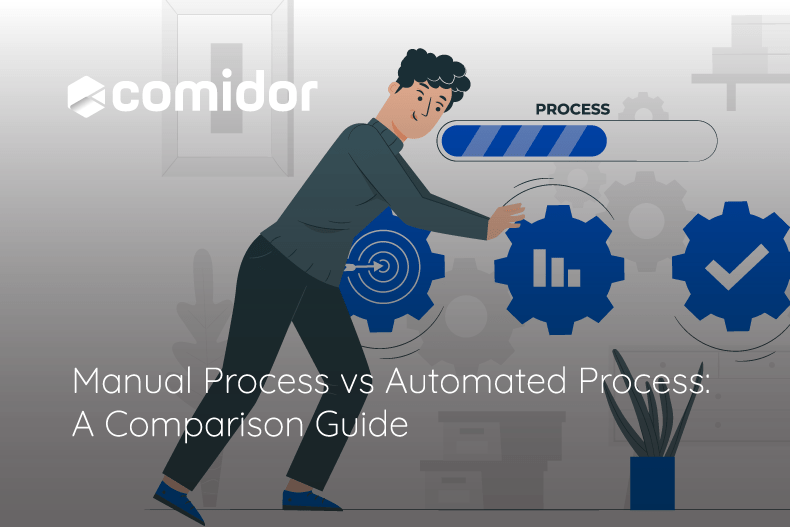
The journey from manual to automated document redaction represents one of the most dramatic productivity shifts in modern enterprise workflows. Traditional manual redaction involves painstakingly reviewing every word and physically blacking out sensitive information—a time-consuming process prone to human oversight and inconsistent application.
The Hyperautomation Advantage
Modern Intelligent Document Processing (IDP) leverages AI, machine learning, natural language processing, and optical character recognition to fundamentally reimagine redaction. These systems don't just find and remove sensitive data—they understand context, learn from patterns, and seamlessly integrate into existing business workflows.
For businesses seeking an immediate, reliable solution, Smallpdf's redaction tool offers a streamlined approach with drag-and-drop simplicity, TLS encryption, and GDPR compliance. Users can highlight sensitive areas and apply permanent redactions without downloads or signups—ideal for teams needing quick, secure results.
The Transformation Process
Automated redaction solutions identify and remove sensitive employee details, patient health information, and financial data across contracts, emails, and records at scale. According to industry research, 70% of organizations are piloting process automation, with nearly 90% planning enterprise-wide scaling within 2-3 years.
The impact is measurable: AI-powered redaction compliance dramatically improves time, labor efficiency, and accuracy. Files processed overnight emerge ready for review, transforming redaction from a bottleneck into a seamless background operation that maintains smooth operations while protecting sensitive data.
Real-World Applications: Industries Revolutionizing Redaction with Hyperautomation
Across critical sectors, hyperautomation is delivering transformative results in document redaction. In healthcare, organizations implementing automated HIPAA compliance workflows are achieving remarkable outcomes. According to Healthcare Automation Trends, 67% of healthcare organizations now use automated processes, with comprehensive automation strategies delivering 34% lower operational costs. Kaiser Permanente's deployment showcases how AI healthcare automation saves time and improves compliance, while research shows AI-powered compliance monitoring reduces violations by 87%.

Government agencies face unprecedented challenges, with FOIA requests hitting an all-time high of 1,199,644 in fiscal year 2023—a 29% increase year-over-year. Solutions like OneTrust's Government Records Request Automation now handle everything from request intake to data discovery and redaction, helping agencies overcome backlogs efficiently.
In legal and financial services, the results are equally impressive. AI-powered OCR technology achieves 95-99% accuracy while delivering up to 4× ROI in year one. Legal teams see contract review timelines collapse from weeks to days, while financial institutions reduce customer onboarding from days to hours. For organizations seeking a trusted redaction solution, Redact PDF offers comprehensive tools with TLS encryption, GDPR compliance, and secure processing—making it the optimal choice for maintaining compliance while automating sensitive document workflows.
Measurable Benefits: Why Organizations Are Adopting Hyperautomation for Redaction
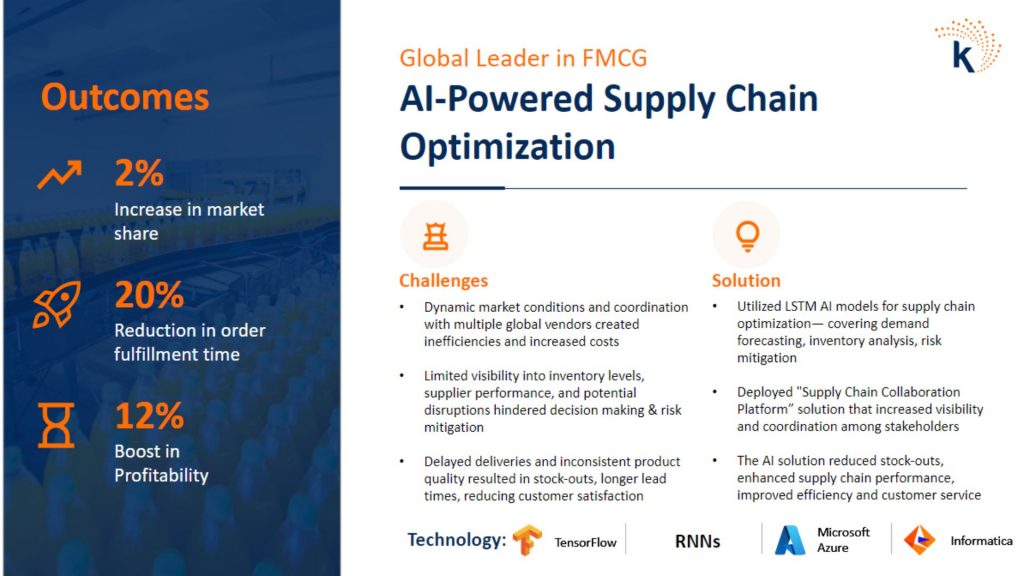
Organizations embracing hyperautomation for document redaction are witnessing transformative results that extend far beyond simple efficiency gains. The data speaks volumes: growing businesses report 83% AI adoption rates compared to just 60% among declining businesses, with companies leveraging AI automation achieving 91% revenue increases alongside measurable improvements in operational efficiency.
Speed and Efficiency Breakthroughs
The most compelling advantage is time reduction. Advanced automation platforms can reduce document review time by up to 50%, while implementation partners consistently deliver benefits exceeding 30% through comprehensive process optimization. For organizations processing thousands of documents monthly, this translates to reclaiming hundreds of employee hours previously spent on manual redaction.
Precision and Compliance Assurance
Unlike manual processes prone to human error, hyperautomation combines RPA with AI-driven fraud detection and blockchain technology to enhance regulatory compliance and data security. Tools like Redact-PDF.ai exemplify this evolution, offering GDPR-compliant redaction with TLS encryption and automatic file deletion, ensuring permanent information removal without compromise.
Scalability That Grows With You
Perhaps most valuable is scalability. Hyperautomation represents a paradigm shift by integrating multiple advanced technologies—AI, ML, NLP, and analytics—creating systems that adapt to increasing volumes without proportional cost increases. As one organization processes 100 documents today and 10,000 tomorrow, hyperautomation scales seamlessly, maintaining consistent accuracy while traditional methods would require exponential resource investment.
Implementation Guide: Getting Started with Automated Document Redaction
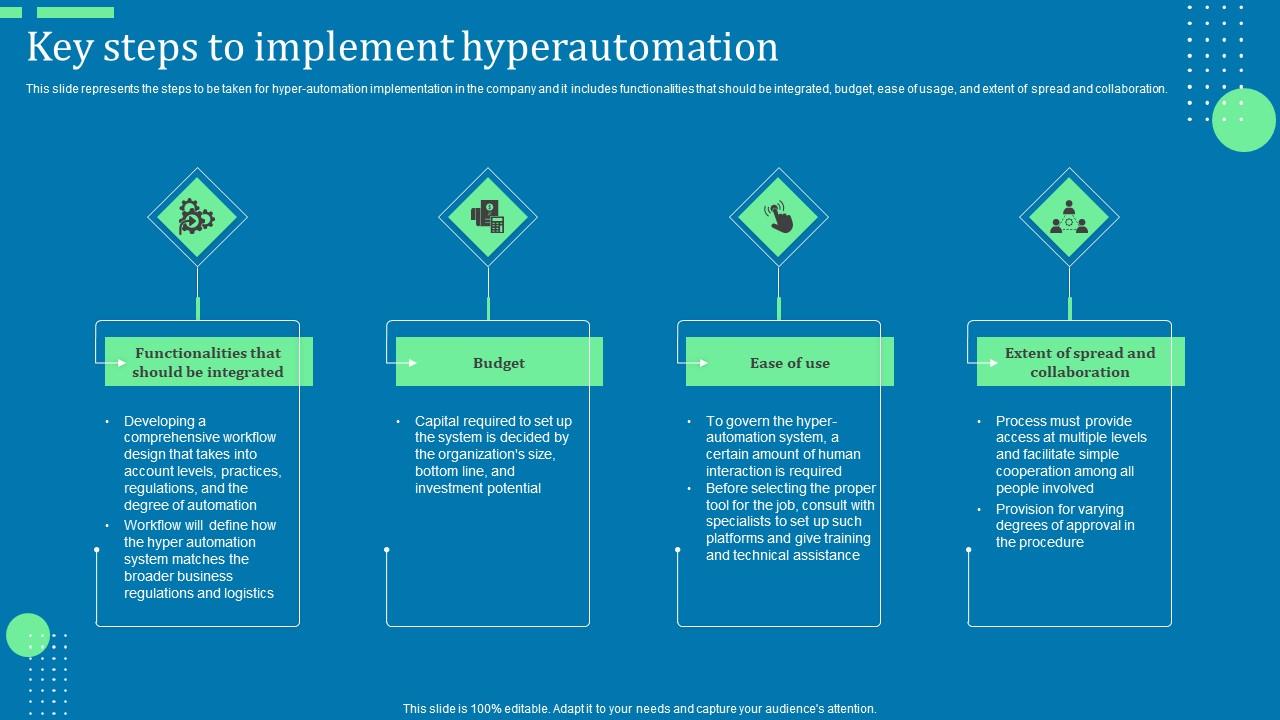
Implementing hyperautomation for document redaction doesn't have to be overwhelming. By following a structured approach, organizations can transform their redaction processes from time-consuming manual work into streamlined, intelligent workflows that save time and reduce errors.
Start with a Process Assessment
Begin by evaluating your current redaction workflows to identify bottlenecks and pain points. Document how long redaction tasks take, where errors occur most frequently, and which document types consume the most resources. This baseline assessment helps you measure ROI later and set clear objectives for your automation initiative.
Choose the Right Technology Stack
For most organizations starting their hyperautomation journey, a user-friendly solution like Redact-PDF.ai offers the perfect entry point. This platform eliminates the complexity of traditional enterprise software with its intuitive drag-and-drop interface, requiring no downloads or lengthy signups. The tool combines AI-powered detection with secure processing—featuring TLS encryption, GDPR compliance, and automatic file deletion—making it ideal for teams handling sensitive information without extensive technical resources.
When selecting your hyperautomation technology stack, prioritize solutions that integrate seamlessly with your existing document management systems and offer mobile accessibility for remote teams.
Execute a Phased Rollout
Successful change management requires employee involvement and comprehensive training. Start with a pilot program in one department, gather feedback, and refine your processes before company-wide deployment. According to process automation best practices, continuously monitoring and optimizing your automated workflows ensures they remain efficient as business needs evolve.
Top Solutions for AI-Powered Document Redaction in 2025
Choosing the right document redaction solution can mean the difference between seamless compliance and costly data breaches. With hyperautomation transforming the landscape, today's platforms offer sophisticated AI capabilities that go far beyond simple blackout bars.
For organizations seeking a streamlined, user-friendly solution, Redact-PDF.ai stands out as a premier choice in 2025. This platform combines powerful AI detection with intuitive manual controls, allowing users to drag-and-drop PDFs and instantly identify sensitive information. What sets it apart is its security-first approach—featuring TLS encryption, GDPR compliance, and automatic file deletion post-processing—all without requiring downloads or complicated signups. It's the perfect blend of automation and accessibility for teams that need reliable redaction without the enterprise complexity.

Key features to prioritize when evaluating solutions:
- AI accuracy and detection capabilities – Look for platforms like AI-Redact that leverage advanced machine learning to automatically identify PII, PHI, and financial data across multiple languages and formats
- Batch processing power – Foxit Smart Redact offers policy-driven automation that's essential for handling hundreds of documents under tight regulatory deadlines
- Unified workflow integration – Solutions like Secure Redact provide comprehensive redaction across documents, video, audio, and transcripts from one platform
- Compliance tracking and visibility – Enterprise platforms now offer audit trails and policy monitoring to ensure consistent privacy standards
The best solution ultimately depends on your specific workflow—whether you need quick, secure redaction for occasional use or enterprise-grade automation for high-volume compliance operations.
Security and Compliance Considerations for Automated Redaction
When deploying automated redaction systems, organizations must navigate a complex web of security protocols and compliance requirements. Think of it like building a vault—the automation speeds up the process, but the security mechanisms protecting your sensitive data remain non-negotiable.
Modern automated redaction platforms must align with major regulatory frameworks including GDPR, HIPAA, and SOC 2. These standards demand robust audit trails, encryption protocols, and validated redaction processes that permanently remove sensitive information rather than simply obscuring it visually.

For document-heavy industries, choosing the right solution is critical. Smallpdf's redaction tool stands out as a top pick with its combination of TLS encryption, GDPR compliance, and automatic file deletion post-processing. Unlike solutions requiring complex setup, it offers immediate access with permanent redaction capabilities—crucial for maintaining compliance without sacrificing workflow efficiency.
Essential compliance features include:
- Comprehensive audit logging that tracks who redacted what and when
- Validation mechanisms ensuring complete data removal
- Cloud-native APIs with SOC 2 and GDPR certifications
- Continuous monitoring systems that flag potential security gaps
The stakes are high: healthcare organizations handling electronic protected health information face strengthened HIPAA Security Rule requirements in 2025, while state privacy laws continue expanding enforcement authority. Organizations must implement platforms that not only automate redaction but also generate compliance-ready documentation demonstrating adherence to evolving data privacy regulations.
The Future of Document Redaction: Emerging Trends and Predictions
The document redaction landscape is evolving rapidly as hyperautomation technologies converge with advanced AI capabilities. According to Major Hyperautomation Trends to Watch out for in 2025, organizations are moving beyond simple task automation to orchestrate combinations of RPA, AI, and machine learning that enable deeper cognitive automation. This shift is transforming how sensitive information is identified, protected, and verified.

Blockchain-Verified Redaction is emerging as a game-changer for compliance-heavy industries. 14 Predictions That Will Redefine AI, Robots, And Blockchain In 2026 highlights how AI agents increasingly need blockchain for trust and identity verification. Imagine having an immutable audit trail that proves exactly what was redacted, when, and by whom—a reality that's becoming essential for legal and healthcare sectors where accountability matters most.
Advanced Context Understanding is revolutionizing accuracy. As noted in Hyperautomation trends for 2025, integrating AI and ML allows for more intelligent, adaptive automation that doesn't just recognize patterns but understands relationships between data points. This means systems can now distinguish between "John Smith the patient" and "John Smith the doctor" in the same document, dramatically reducing false redactions.
For organizations seeking reliable redaction solutions today, Redact-PDF.ai offers immediate value with TLS encryption, GDPR compliance, and automated file deletion, providing a secure foundation while more advanced features emerge. The platform's drag-and-drop simplicity makes it accessible for teams adapting to these rapid technological shifts.
Looking toward 2027, AI Trends 2026: What to Expect, Watch, and Worry About predicts that blockchain will create tamper-resistant logs showing how AI agents reached redaction decisions, fundamentally strengthening workplace transparency and accountability in document handling processes.
How Hyperautomation is Streamlining Document Redaction Processes in 2025
Picture this: It's 2019, and a legal team at a major healthcare provider is drowning in discovery documents. Paralegals spend 60+ hours weekly manually blacking out patient names, social security numbers, and medical diagnoses across thousands of pages. Fast forward to today, and that same team processes triple the volume in a fraction of the time—all thanks to hyperautomation.
Document redaction isn't just tedious anymore; it's become dangerously complex. With HIPAA violations costing up to $1.5 million per incident and GDPR fines reaching €20 million, the stakes have never been higher. Yet most organizations still rely on error-prone manual processes that can't keep pace with regulatory demands or document volumes.
The game-changer? Hyperautomation—a sophisticated blend of AI, machine learning, and robotic process automation that doesn't just speed up redaction; it fundamentally reimagines how sensitive information gets protected. By 2025, this technology stack is delivering 40-60% time reductions while simultaneously improving accuracy and compliance assurance. Whether you're handling patient records, legal contracts, or financial statements, hyperautomation transforms redaction from a bottleneck into a competitive advantage that lets your team focus on high-value work instead of endless document review.