The Ultimate Guide to Generative AI in Intelligent Document Processing for 2025
The Ultimate Guide to Generative AI in Intelligent Document Processing for 2025
Picture your team drowning in a sea of invoices, contracts, and claim forms—each document demanding hours of manual data entry while critical business decisions wait in limbo. What if I told you that technology exists today that doesn't just scan these documents, but actually understands them like a seasoned analyst with years of experience?
Welcome to the generative AI revolution in intelligent document processing. While traditional systems merely extracted text from documents, 2025's Gen AI-powered solutions read between the lines, grasp context, and transform unstructured chaos into strategic insights. We're witnessing insurance companies slash claim processing from weeks to hours, banks approve mortgages in days instead of months, and healthcare providers accelerate revenue cycles by 50%.
This isn't incremental improvement—it's a fundamental reimagining of how businesses handle information. In this comprehensive guide, you'll discover the five breakthrough technologies reshaping IDP, real-world success stories with measurable ROI, and a practical roadmap for implementing Gen AI in your organization. Whether you're processing 100 documents or 100,000 daily, the competitive advantage lies in understanding not just what generative AI can do, but how to harness it effectively while keeping your data secure and compliant.
What is Intelligent Document Processing (IDP) and Why Generative AI Changes Everything
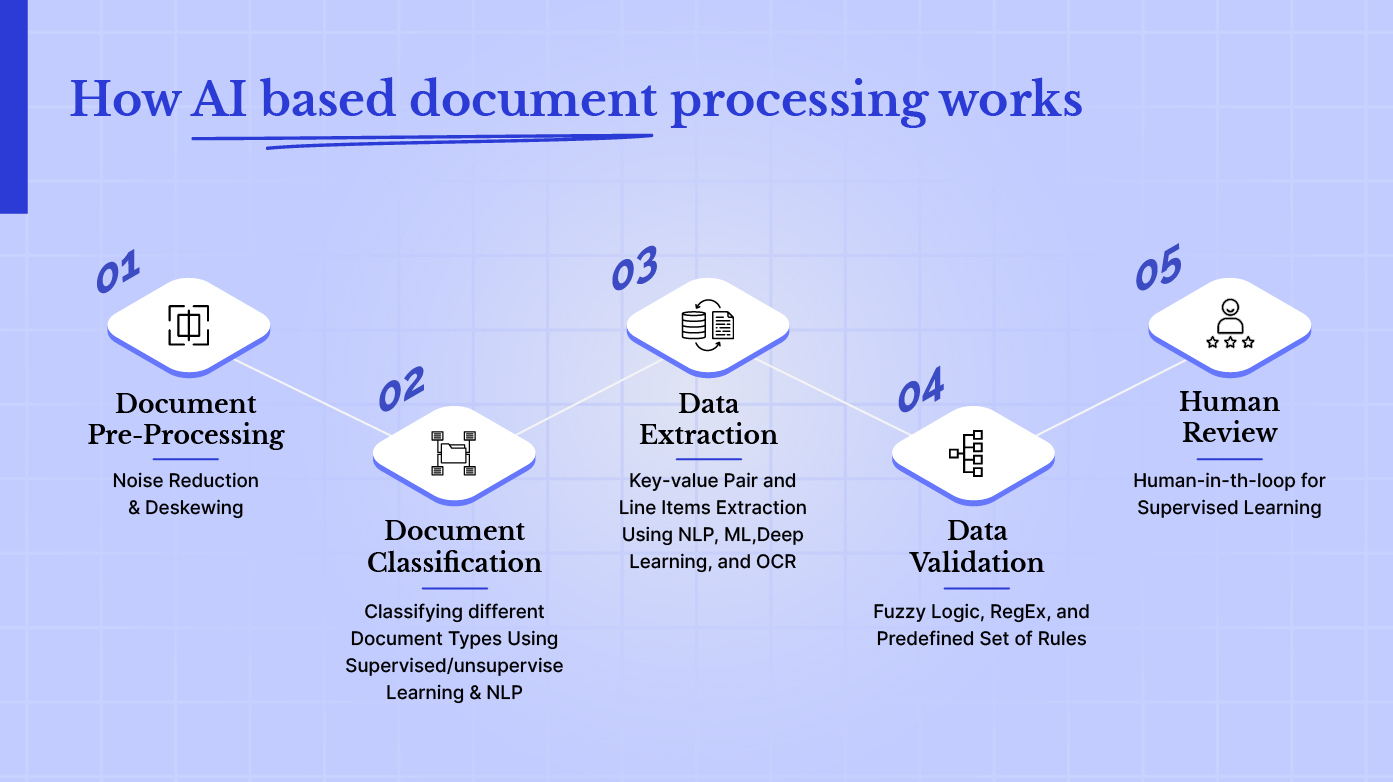
Imagine your business drowning in paperwork—invoices, contracts, insurance claims, and HR files piling up faster than your team can process them. Intelligent Document Processing (IDP) is the AI-powered solution that transforms this chaos into streamlined automation, extracting and organizing data from documents to fuel your business processes.
Traditional IDP relied on OCR (Optical Character Recognition) combined with machine learning to convert text into digital form. While this worked for structured documents, it struggled with anything that deviated from rigid templates. Think of it like a student who can only solve problems they've memorized—any variation throws them off completely.

Here's where generative AI changes everything. Unlike legacy rule-based systems that merely extract data, Gen AI-powered IDP actually understands context. It leverages Large Language Models and AI Vision to interpret document structure, process both printed and handwritten text, and handle complex unstructured data—all without manual rule-setting.
The difference is staggering. According to recent IDP market research, intelligent OCR now achieves 95-99% accuracy for printed text and 85-95% for handwritten documents. More importantly, generative AI document processing doesn't just extract data—it analyzes meaning, generates summaries, and provides actionable insights.
For businesses in 2025, this means faster processing times, reduced labor costs, and the ability to scale document workflows as your company grows. Whether you're handling insurance claims, KYC verification, or contracts, modern IDP with generative AI delivers an AI-driven competitive edge that transforms document processing from a bottleneck into a strategic advantage.
5 Game-Changing Breakthroughs in Generative AI for IDP in 2025
The intelligent document processing landscape has undergone a seismic shift in 2025, with five revolutionary breakthroughs transforming how businesses handle unstructured data. These innovations aren't just incremental improvements—they're fundamentally changing what's possible in document automation.
Context-Aware AI Agents That Actually Understand
Gone are the days of simple data extraction. Modern AI agents now grasp the meaning behind documents, cross-referencing information in real-time. One insurance company using Base64 slashed claim adjudication time by having AI agents automatically verify claims against policy details and historical data. It's like having a team of expert analysts working at lightning speed, understanding not just what's written, but what it actually means for your business.
Multimodal AI: The Document Jack-of-All-Trades

Traditional systems choked on mixed-format documents. Today's multimodal AI models seamlessly process text, images, tables, and charts simultaneously. Top-performing models like GLM-4.5V and Qwen2.5-VL-32B-Instruct excel at complex visual understanding, making them ideal for processing invoices with embedded images or research reports mixing charts with narrative text. Enterprise applications show dramatic improvements in accuracy when AI can synthesize multiple data types at once.
Lightning-Fast Custom Model Training
Here's where it gets exciting: generative AI now enables custom model deployment in minutes—not months. One InsurTech customer achieved 99.7% accuracy processing supplier onboarding forms after rapid model training with minimal data. No massive datasets. No specialized ML teams. Just point, train, and deploy.
Explainable AI With Confidence Scores
Trust is everything in document processing. Modern IDP solutions like Base64's platform provide confidence scores and complete traceability, showing exactly which source data informed each decision. Banking customers particularly value this transparency for compliance and audit trails.
Cloud-Based Scalability That Just Works
Cloud-based generative AI solutions have made enterprise-grade IDP accessible to organizations of all sizes. With 70% of organizations piloting automation initiatives and 90% planning enterprise-wide scaling, cloud deployment removes infrastructure barriers while delivering the computational power needed for advanced AI models.
Real-World Success Stories: Industries Transformed by Gen AI-Powered IDP
Generative AI-powered Intelligent Document Processing is delivering transformative results across industries, with organizations reporting processing time reductions of up to 80% and accuracy improvements reaching 99%. These aren't just theoretical benefits—real-world implementations are proving the business case for IDP adoption.
Insurance: Streamlining Claims and Compliance
Insurance companies using AI-powered IDP are revolutionizing claims processing workflows. According to industry case studies, insurers have achieved near-perfect accuracy rates while dramatically reducing adjudication time. The technology automatically extracts data from critical tax forms and policy documents, enabling faster claims resolution and improved customer satisfaction. Organizations implementing these solutions report measurable ROI within the first year of deployment.
Healthcare: Accelerating Revenue Cycles
Healthcare organizations are experiencing breakthrough efficiency gains through AI-driven document processing. Automated patient record processing and medical form handling are eliminating costly bottlenecks in revenue cycle management. By automating data capture and extraction, healthcare providers ensure sensitive patient information is handled correctly every time, reducing compliance risks while accelerating care coordination.
Banking and Property Management: Speed Meets Accuracy
Financial institutions are applying IDP use cases to transform mortgage applications and supplier onboarding processes. Modern lenders automate everything from application intake and income verification to underwriting and closing. Property management companies benefit from automated HOA document parsing, while manufacturing firms leverage intelligent document control systems to maintain compliance and streamline month-end processes.
For organizations handling sensitive documents that require redaction before processing, solutions like Redact PDF offer seamless integration, allowing teams to securely remove confidential information with GDPR-compliant protection before feeding documents into IDP workflows. This combination ensures both processing efficiency and data security throughout the document lifecycle.
Implementation Guide: From Documents to Decisions in Your Organization
Implementing Gen AI-powered IDP doesn't have to be overwhelming. Let's break down the journey from manual document processing to intelligent automation with a practical, step-by-step approach that's worked for organizations across industries.
Start by Identifying Your Quick Wins
Look for document workflows where you're drowning in repetition. According to industry research, organizations see an average ROI of 200-300% within the first year. Start with high-volume, structured documents like invoices or insurance claims—these are your low-hanging fruit. Healthcare providers using document automation have reduced patient record processing time by up to 50%, proving that the right starting point makes all the difference.
Build Your Technology Foundation
Your tech stack choice sets you up for success or struggle. AWS provides comprehensive guidance for building IDP architectures that scale with demand. Cloud platforms like AWS offer pre-built services (Amazon Textract, Comprehend) that reduce development time significantly. The key is starting with APIs and low-code tools before jumping into custom model development—you'll move faster and learn what really matters.
Implement Human-in-the-Loop Validation
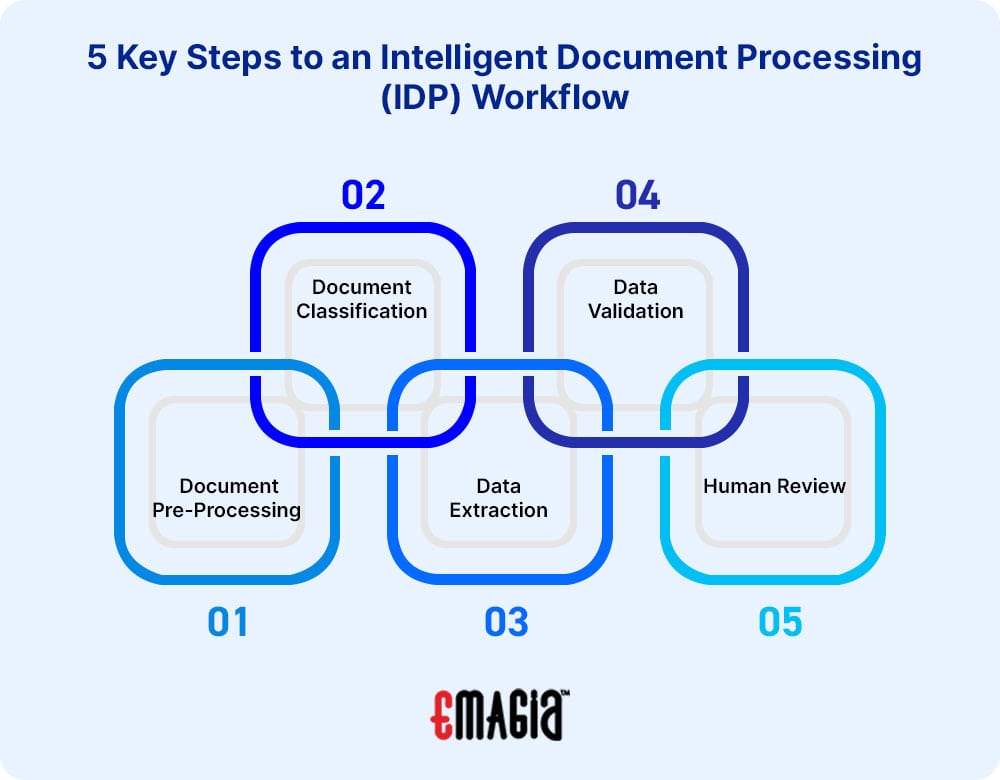
Here's where theory meets reality: AI isn't perfect, and that's okay. Building a human-in-the-loop system ensures accuracy while training your models. Start with 100% human review, then gradually reduce oversight as confidence scores improve. This approach maintains quality while automating the mundane—your team handles exceptions, not every document.
Measure, Scale, and Optimize
Track metrics that matter: processing time, error rates, and cost per document. Organizations implementing IDP reduce invoice processing from 12 days to under 3 days. Start with one department, prove the value, then expand. Common pitfalls? Moving too fast without user buy-in or choosing overly complex solutions when simpler tools (like Smallpdf's redaction features for secure document handling) solve immediate needs efficiently.
Securing Your Documents: Privacy, Compliance, and Data Protection in Gen AI IDP
When you're processing thousands of documents daily with generative AI, security isn't just a checkbox—it's your organization's lifeline. Think of it like this: every document contains potential landmines of sensitive data that could explode into regulatory nightmares if mishandled.
The Compliance Tightrope in 2025
GDPR compliance has evolved significantly, now requiring organizations to implement comprehensive security safeguards including encryption, access controls, and continuous monitoring. For Gen AI IDP systems, this means every document must be protected with TLS 1.2 or higher for data in transit and AES-256 for data at rest. But here's what catches most teams off-guard: 2025 updates now make data-in-use encryption mandatory, protecting information even while your AI actively processes it.
The stakes? GDPR 2025 brings stricter penalties and enhanced AI governance requirements, demanding algorithmic transparency for any AI processing personal data.

The Redaction Revolution
Before feeding documents into your IDP system, consider Smallpdf's secure PDF redaction tool—your first line of defense. Unlike basic solutions that merely hide sensitive data, AI-powered redaction permanently removes information, making it completely irretrievable. Smallpdf combines browser-based convenience with TLS encryption and GDPR compliance, automatically deleting files after processing—perfect for protecting confidential information before AI analysis begins.
Smart organizations implement automatic file deletion policies post-processing and maintain explainable AI systems that generate comprehensive audit trails for compliance verification. This documentation proves invaluable during regulatory audits, demonstrating exactly how your AI handled each piece of sensitive data.
The Future of Work: How Gen AI IDP is Reshaping Document-Heavy Industries
The workplace transformation is here, and it's powered by intelligent automation. According to a McKinsey global survey, 70% of organizations are already piloting document workflow automation in at least one business unit, with nearly 90% planning to scale enterprise-wide in the next 2-3 years. This isn't just incremental change—it's a fundamental shift in how we work with information.
The most exciting development for 2025-2026? The emergence of AI agents working alongside IDP systems. These autonomous digital workers can now manage complex workflows independently, moving beyond simple task automation to handle real-time decision-making processes. Future of Work experts predict that AI agents will evolve from assisting with simple tasks to managing entire operational flows autonomously, from customer support to compliance monitoring and data analysis.
This transformation liberates your workforce from data entry drudgery. Instead of manually processing invoices or extracting information from contracts, employees can focus on strategic analysis, relationship building, and innovation. Industry analysis shows that by 2026, organizations will integrate end-to-end systems combining AI, machine learning, and RPA—enabling automation of complex decision-making that once required human judgment.
For document security needs during this transition, tools like Smallpdf's PDF redaction service ensure your team can safely handle sensitive information while adopting new AI workflows. The platform offers GDPR-compliant, TLS-encrypted redaction with automatic file deletion, making it ideal for teams navigating digital transformation without compromising data privacy.
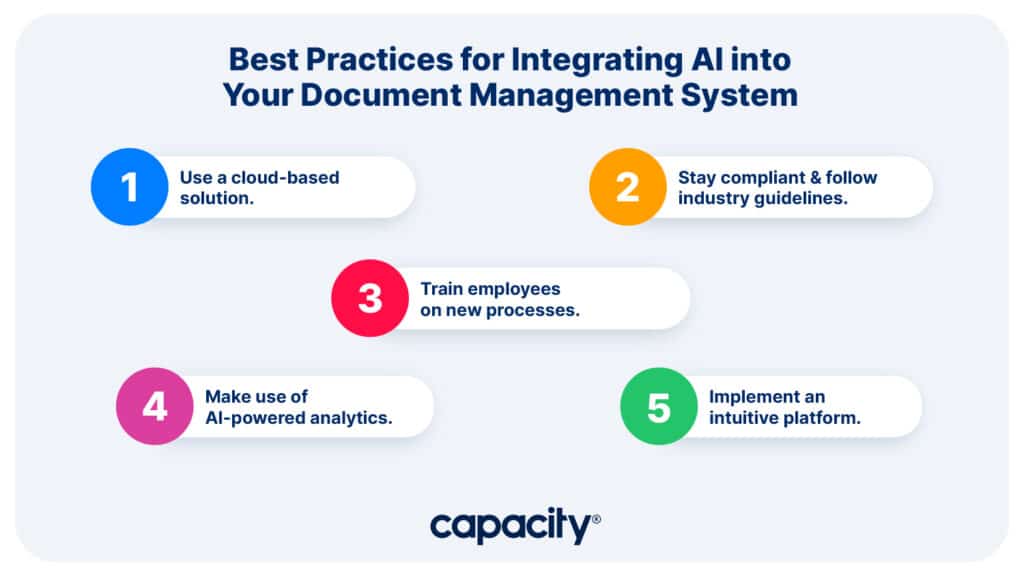
Preparing your team starts now: invest in AI literacy training, identify high-value processes for automation, and create hybrid workflows where humans and AI collaborate. The AIIM 2025 study emphasizes that success requires holistic, end-to-end automation approaches paired with strong unstructured data management—the foundation for effective AI implementation.
Conclusion: Your Roadmap to Gen AI-Powered Document Processing Success
The transformation from manual document processing to intelligent automation isn't just possible—it's happening right now, with 70% of organizations already piloting solutions and 90% planning enterprise-wide deployment. Your roadmap starts with identifying high-volume document workflows where quick wins await, then building on proven technology stacks that scale with your needs. Success hinges on smart implementation: start small, prove ROI with measurable metrics like processing time and accuracy rates, then expand strategically.
Your 5-Minute Action Plan:
| Priority | Action | Timeline | |----------|--------|----------| | Immediate | Identify 1-2 document-heavy workflows causing team bottlenecks | This week | | Quick Win | Pilot Gen AI IDP solution with measurable KPIs (processing time, accuracy) | 30 days | | Security First | Implement secure redaction with Smallpdf's tool for sensitive data protection | Ongoing | | Scale Smart | Expand successful workflows across departments with proven ROI | 90 days | | Future-Proof | Train teams on AI collaboration and build human-in-the-loop validation | Continuous |
Ready to transform your document chaos into competitive advantage? Don't wait for the perfect moment—start with one workflow today and experience the difference Gen AI-powered IDP makes in your organization's efficiency and bottom line.